
Feeling overwhelmed by the endless options for online advertising? If you’re worried about wasting your hard-earned marketing budget on campaigns that don’t reach customers in your specific service area, you’re not alone. The key to attracting more customers and achieving a strong return on investment isn’t about being everywhere-it’s about being in the right places. This is where a targeted local ad strategy becomes your most powerful tool for growth, ensuring your message is seen by the people most likely to become your next loyal clients.
But where do you even begin? From Google and Facebook to local directories, the landscape can feel complex. This complete guide is designed to simplify it all. We will break down the different types of local advertising, help you understand which channels are most effective for your business, and walk you through the basic steps to create a successful campaign. By the end, you’ll have the clarity and confidence to invest wisely in a strategy that brings new customers through your door.
What Are Local Ads? (And Why Your Business Can’t Afford to Ignore Them)
In a crowded market, shouting to everyone is rarely an effective strategy. Local advertising is the art of speaking directly to the customers right outside your door. Unlike broad national campaigns that cast a wide, expensive net, a local advertising strategy focuses your marketing budget with laser precision on a specific geographic area-your city, your neighborhood, or even a few blocks around your business. It’s about reaching the right people, in the right place, at the exact moment they need your services.
To see how this works in practice, particularly with powerful platforms like Google, watch this helpful overview:
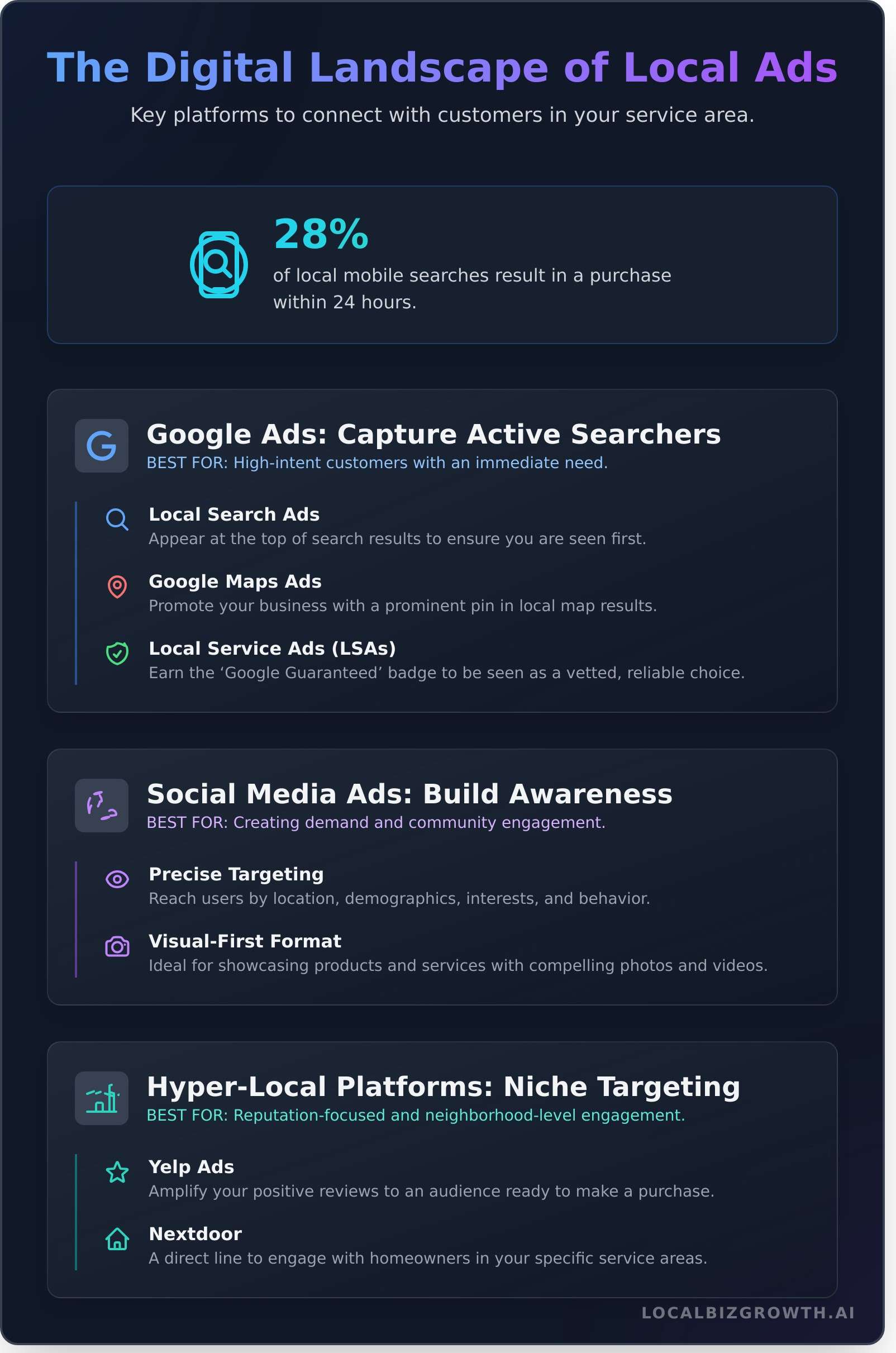
The core benefit of this approach is simple: it connects you with customers who have a high intent to buy. When someone searches for “plumber near me” or “best coffee shop in [Your Town],” they have an immediate need. In fact, research shows that 28% of local mobile searches result in a purchase within 24 hours. For a small business, this is a game-changer. A targeted local ad allows you to compete effectively with larger chains by being the most relevant, convenient answer for nearby customers looking to make a purchase now.
The Power of Proximity and Intent
Local ads capitalize on the powerful combination of proximity and intent. You aren’t trying to create demand; you are capturing existing demand from active searchers. This is especially true on mobile devices, where the majority of local searches occur. Every targeted ad not only drives immediate leads but also builds crucial brand awareness within your community, making your business the go-to choice for local patrons.
Digital vs. Traditional Local Ads: A Quick Comparison
While traditional local marketing has its place, digital methods offer unparalleled advantages for tracking ROI. Here’s a quick breakdown:
- Traditional Methods: Flyers, local newspaper ads, and radio spots. These can build general awareness but are difficult to measure and offer limited targeting options.
- Digital Methods: Google search ads, targeted social media campaigns, and listings on local directories. These tools provide precise geographic and demographic targeting, detailed analytics, and a clear path to measuring your return on investment.
The Digital Landscape: Top Platforms for Local Ads Today
Navigating the digital world to find new customers can feel overwhelming. The key is knowing where your target audience spends their time online. The most effective local ad platform is not a one-size-fits-all solution; it depends entirely on your business type, your goals, and your ideal customer’s habits. Choosing the right channel is a foundational part of the effective local marketing strategies that drive real growth. For most small businesses, the landscape is dominated by two powerful players: Google and Social Media.
Google Ads for Local Businesses
When a potential customer has an immediate need-like a leaky pipe, a broken-down car, or a craving for takeout-their first stop is almost always Google. Google Ads allows you to capture this high-intent audience at the exact moment they are searching for a solution. Key formats include:
- Local Search Ads: These ads appear at the top of Google search results when people in your area search for your products or services, ensuring you are seen first.
- Google Maps Ads: Promote your business with a prominent pin at the top of local map results, making it easy for nearby customers to find and visit you.
- Google Local Service Ads (LSAs): Earn the ‘Google Guaranteed’ trust badge and appear at the very top of search results, positioning your business as a vetted, reliable choice.
These ad types are incredibly effective for service-based businesses where attracting customers with urgent needs is critical for generating leads and revenue.
Social Media Ads (Facebook & Instagram)
While Google captures active searchers, social media platforms like Facebook and Instagram build awareness and create demand. These platforms allow you to run highly targeted campaigns based on user location, demographics, interests, and online behavior, putting your message in front of the right people before they even know they need you.
The visual-first format is perfect for businesses like restaurants, retail boutiques, and home service providers who can showcase their work with compelling photos and videos. More than just advertising, it’s a powerful way to build a local community and engage directly with your customers. Not sure where to start? Let our AI-powered strategies find your customers.
Other Hyper-Local Platforms
Beyond the giants, niche platforms can offer significant value. For businesses where reputation is everything, Yelp Ads can amplify your positive reviews to an audience ready to make a purchase. For those focused on neighborhood-level engagement, Nextdoor provides a direct line to homeowners in your specific service area. While often used as supplementary channels, they can be powerful tools for the right type of local business.
How to Create a Winning Local Ad Strategy in 3 Steps
Effective digital marketing isn’t about spending the most money; it’s about spending money the most effectively. Before you launch your first campaign, a clear strategy is essential to maximize your return on investment and avoid wasted spend. This simple, three-step process is designed to help any local business deliver the right message to the right person at the right time, converting prospects into paying customers. While it’s helpful to understand what local marketing is conceptually, executing it with a plan is what drives real growth.
Step 1: Define Your Target Customer & Service Area
Success starts with precision. Go beyond just your city and define who your ideal customer is. Consider their demographics, income level, and, most importantly, the specific problems they need you to solve. Then, set a precise geographic service area using zip codes or a radius around your business. We advise starting with a smaller, more concentrated area where you have a strong presence. You can always expand as you see positive results and generate a consistent flow of leads.
Step 2: Set a Realistic Budget and Clear Goals
Your budget should align with clear, measurable goals. What action do you want customers to take after seeing your local ad? Common objectives include:
- Increasing phone calls for appointments
- Driving traffic to your website to book a service
- Generating foot traffic to your physical store
Start with a small, testable budget you are comfortable with. Most platforms use a pay-per-click (PPC) model, where you only pay when someone clicks your ad. While metrics like impressions are useful, your primary focus should be on your cost-per-lead-the ultimate indicator of your ROI.
Step 3: Craft an Irresistible Local Offer
A great ad needs a compelling offer that gives customers a reason to click now. Your message should immediately communicate value and solve a problem. Think about what would motivate your target customer. Effective offers often include:
- Discounts: ‘15% Off Your First Service’
- Free Value: ‘Get a Free, No-Obligation Consultation’
- Urgency: ‘Same-Day Service Available Today’
Finally, every ad must have a clear Call to Action (CTA). Tell users exactly what to do next with direct commands like ‘Call Now,’ ‘Get Directions,’ or ‘Book Online Today.’
Measuring Success: How to Know if Your Local Ads Are Working
The single biggest advantage of digital marketing over traditional methods is trackability. Gone are the days of buying a newspaper ad and simply guessing if it generated any business. With a well-managed local ad campaign, you can see exactly what works and what doesn’t, allowing you to make data-driven decisions that directly impact your bottom line. The goal isn’t to chase “vanity metrics” like likes or shares; it’s to measure real-world business outcomes and generate a clear Return on Investment (ROI).
Key Metrics That Actually Matter for Local Businesses
To understand your ad performance, you need to focus on the metrics that translate into tangible growth. While many numbers are available, only a few are critical for a local business to attract new customers.
- Clicks & Impressions: These are the basics. Impressions tell you how many times your ad was shown, while clicks tell you how many people took the first step to engage with your business.
- Click-Through Rate (CTR): This percentage shows how compelling your ad is. A higher CTR means your message and visuals are effectively resonating with your target audience.
- Conversions: This is the most important metric. A conversion is a specific, valuable action a user takes, such as calling your business, filling out a contact form, or booking an appointment directly from your ad.
- Cost Per Conversion: This tells you exactly how much you are paying to generate one new lead. A lower cost per conversion means your ad spend is more efficient and profitable.
Calculating Your Return on Ad Spend (ROAS)
The ultimate measure of success is whether your advertising is profitable. Return on Ad Spend (ROAS) calculates this for you with a simple formula:
(Revenue from Ads – Cost of Ads) / Cost of Ads = ROAS
For example, let’s say a local contractor spends $500 on a Google Ads campaign. That campaign generates five new leads, and they close two of those jobs for a total of $4,000 in new revenue.
The calculation would be: ($4,000 Revenue – $500 Cost) / $500 Cost = 7. This means for every $1 invested in this campaign, the contractor generated $7 in return. A positive ROAS proves your ads are a profitable engine for growth.
Accurately connecting revenue back to specific ads can be complex. Our AI-powered CRM helps track every lead to calculate your exact ROI, simplifying the process and giving you a clear picture of your marketing success.
Turn Local Clicks into Loyal Customers
Mastering local advertising is no longer a luxury for small businesses-it’s a necessity for growth. As we’ve explored, understanding the right platforms, building a data-driven strategy, and consistently measuring your ROI are the foundational pillars of success. A well-executed local ad campaign doesn’t just put your name on the map; it actively drives foot traffic and phone calls from customers in your community who are ready to buy.
But you don’t have to navigate this complex landscape alone. At Local Biz Growth, we simplify online marketing and deliver tangible results. Our expert team leverages AI-powered ad targeting across Google and Social Media to ensure your message reaches the right people for maximum ROI. We operate on a results-based model with no long-term contracts because we are confident in our ability to help you grow.
Ready to attract more local customers and see a real return on your investment? Get a free consultation today! Let’s start growing your business, one local customer at a time.
Frequently Asked Questions
How much should a small business spend on local ads?
A common benchmark for a small business is to allocate 7-12% of your total revenue to your marketing budget. The exact amount you should spend on local ads depends on your industry’s competitiveness and your specific growth goals. Instead of focusing on a fixed number, we recommend a results-based approach. Start with a budget that allows for effective testing and optimization, then scale your investment as you begin to see a clear and profitable return on investment (ROI).
What is the most effective form of local advertising?
The “most effective” advertising depends entirely on your target customer and business type. For service businesses where customers have an immediate need, like plumbers or electricians, Google Ads are incredibly powerful for capturing high-intent searches. For businesses that are more visual or community-focused, such as restaurants or boutiques, targeted social media ads on platforms like Facebook and Instagram can be more effective for building awareness and attracting new customers. A strategic, integrated approach often yields the best results.
How can I advertise my local business for free?
While paid ads generate the fastest results, you can build a strong foundation for free. Start by fully optimizing your Google Business Profile with high-quality photos, detailed service descriptions, and consistent posts. Actively encourage satisfied customers to leave positive online reviews, as this social proof is invaluable. You can also engage with your community by posting valuable content in local Facebook groups and collaborating with other non-competing local businesses to cross-promote.
Are Facebook ads or Google ads better for a local business?
Neither is inherently “better”-they serve different strategic purposes. Google Ads are ideal for capturing existing demand, targeting users who are actively searching for your products or services right now. This makes them excellent for generating immediate leads. Facebook Ads are designed to create demand by reaching potential customers based on their interests, demographics, and behaviors. This is powerful for building brand awareness and reaching people before they even know they need you.
What is the difference between a local ad and a Google Local Service Ad?
A standard Google local ad is a pay-per-click ad that directs users to your website or landing page. In contrast, a Google Local Service Ad (LSA) is a pay-per-lead format for eligible service-area businesses. LSAs appear at the very top of search results, feature a “Google Guaranteed” badge to build trust, and are designed to generate direct phone call leads. You only pay when a qualified customer contacts you through the ad, making it a highly effective tool.
How long does it take for local ads to start working?
You can start seeing traffic and initial leads from paid local ad campaigns within the first week of launch. However, achieving a consistent and optimized ROI takes time. The first 30-90 days are a critical data-gathering and optimization period where we refine targeting, test ad copy, and identify what converts best. True momentum and predictable growth typically build after this initial phase, as the campaign is calibrated for peak performance and efficiency.