
You know social media is a powerful tool for growth, but finding the time to post consistently feels impossible. You’re juggling daily operations, and the pressure to create engaging content that actually attracts new customers can be overwhelming. Worse yet, you’re investing time and maybe even money, but you have no clear way to tell if it’s actually working. This common challenge is precisely where effective social media management for small companies makes the difference between spinning your wheels and driving measurable growth.
This comprehensive guide is designed to simplify your online marketing and give you back your time. We’ll break down what social media management truly involves, from strategy and content creation to analytics and advertising. You will discover how to choose the right platforms for your business, decide between a DIY approach and hiring an expert agency, and determine a realistic budget that will genuinely grow your business. By the end, you’ll have a clear, manageable plan to attract customers, measure your success, and feel confident that you are investing your marketing budget wisely.
What is Social Media Management? (Hint: It’s More Than Just Posting)
Many business owners believe social media is about scheduling a few posts a week. In reality, effective social media management for small companies is the strategic process of creating, publishing, and analyzing content to manage your entire online presence. It moves beyond simple broadcasting to build a dynamic, two-way relationship with your audience. To get a foundational overview, it’s helpful to understand what social media management encompasses as a key part of digital marketing. It’s about turning followers into loyal customers who champion your brand.
To see this strategy in action, watch this helpful overview from The Wall Street Journal:
The core of this process involves a continuous cycle: listening to what your audience says, analyzing performance data to see what works, engaging in meaningful conversations, and ultimately, converting followers into leads. The ultimate goal of professional social media management isn’t just to gain likes; it’s to build a thriving community and drive measurable business results that contribute directly to your bottom line.
The Strategic Difference: Proactive vs. Reactive Social Media
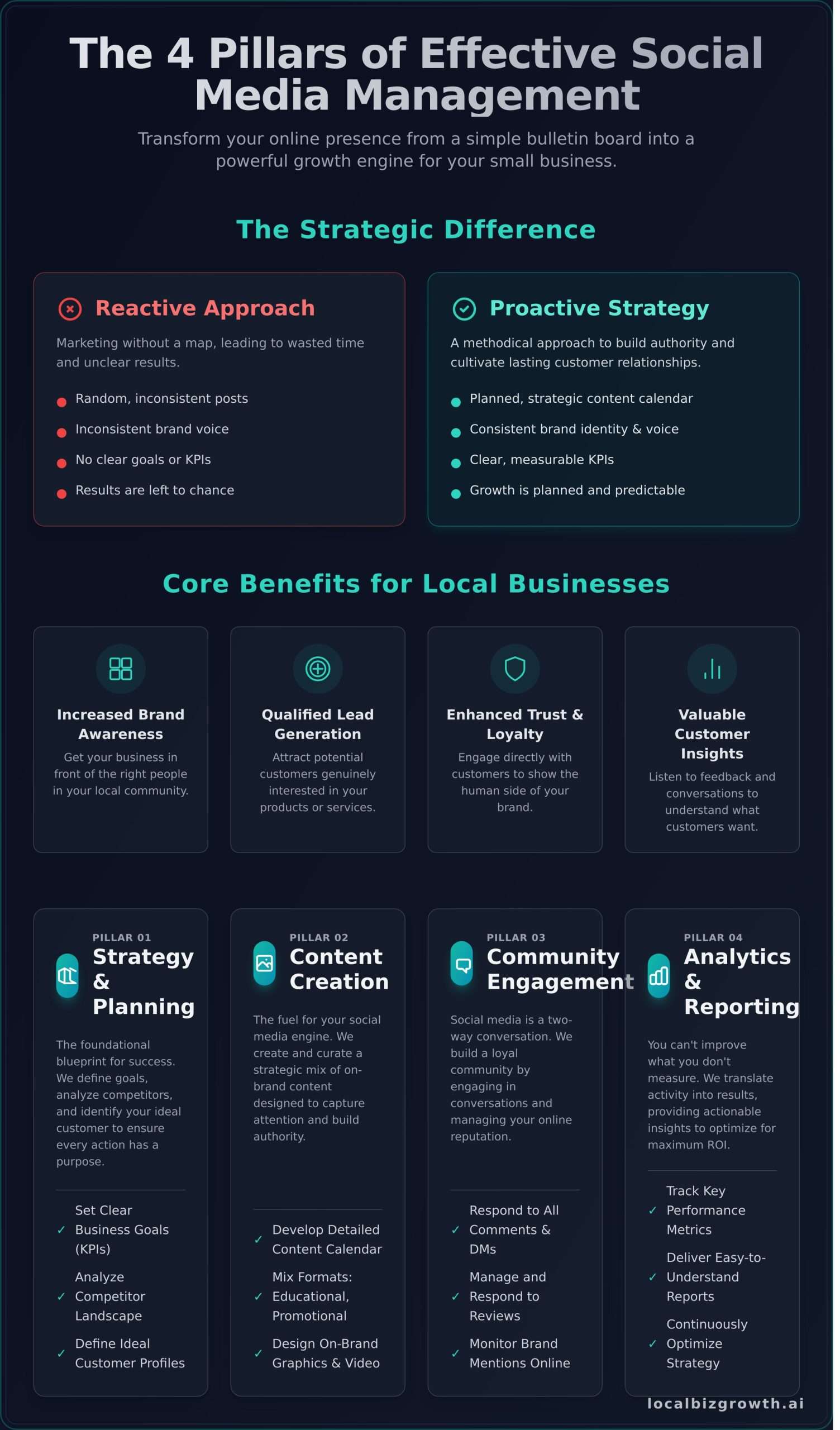
A reactive approach involves random posts, an inconsistent brand voice, and no clear goals-it’s marketing without a map. In contrast, a proactive strategy is built on a planned content calendar, a consistent brand identity, and clear Key Performance Indicators (KPIs). This methodical approach allows you to build genuine brand authority and cultivate lasting customer relationships, transforming your social channels from a simple bulletin board into a powerful growth engine.
Core Benefits for a Small Local Business
For a local business, a strategic social media presence delivers tangible ROI. It’s not just about being online; it’s about being effective. Key benefits include:
- Increased Local Brand Awareness: Get your business in front of the right people in your community, ensuring you’re the first name they think of.
- Qualified Lead Generation: Attract potential customers who are genuinely interested in your products or services, driving both foot traffic and website visits.
- Enhanced Trust and Loyalty: Engage directly with your customers, answer their questions, and show the human side of your brand to build lasting loyalty.
- Valuable Customer Insights: Listen to feedback, reviews, and conversations to understand what your customers truly want and how you can better serve them.
The 4 Pillars of an Effective Social Media Management Strategy
Successful social media doesn’t happen by accident. It’s the result of a deliberate, strategic process designed to attract customers and deliver a measurable return on investment. Effective social media management for small companies is built on a proven framework of four essential pillars. Understanding this structure helps you see the depth of work involved and how each component directly contributes to your business growth.
Pillar 1: Strategy and Planning
Every successful campaign begins with a solid blueprint. This foundational stage involves defining your ideal customer on each platform, setting clear business goals (KPIs) like lead generation or website clicks, and analyzing competitors to identify opportunities. This initial planning is the most critical step, a point reinforced in nearly every expert guide to social media marketing. We ensure you’re on the right platforms-a strategy for a local plumber on Facebook will look very different from a fashion boutique on Instagram.
Pillar 2: Content Creation and Curation
Content is the fuel for your social media engine. This pillar is all about creating and curating posts that capture attention and build authority. We develop a detailed content calendar and a strategic mix of formats to keep your audience engaged:
- Educational posts that solve your customers’ problems.
- Promotional content that drives direct leads and sales.
- Behind-the-scenes updates that build trust and personality.
Every graphic is designed on-brand and every caption is written to convert.
Pillar 3: Community Engagement and Management
Social media is a two-way conversation. This pillar is dedicated to building a loyal community around your brand. It includes promptly responding to all comments and messages, managing online reviews, and proactively engaging with your followers’ content to strengthen relationships. We also monitor for mentions of your brand across platforms, allowing you to join relevant conversations and manage your online reputation effectively. This turns passive followers into active customers.
Pillar 4: Analytics and Reporting
You can’t improve what you don’t measure. The final pillar translates activity into results. We track the key metrics defined in your strategy to see what’s working and what isn’t. Each month, you receive a clear, easy-to-understand report that goes beyond numbers, providing actionable insights on audience growth, engagement, and lead generation. This data-driven approach allows us to continually optimize your strategy, ensuring your investment generates maximum ROI.
DIY vs. Hiring an Agency: A Decision Framework for Small Companies
Deciding on the right approach to social media management for small companies can feel overwhelming. Should you handle it yourself or partner with an expert agency? The best choice depends entirely on your business’s current resources. To make a confident decision, evaluate your position based on three critical factors: your available time, your marketing budget, and your in-house expertise.
When to Manage Social Media In-House (DIY)
Handling your own social media is a practical choice when you have more time than money, especially in the early stages. If you genuinely enjoy connecting with customers online and are eager to learn, the DIY route can be highly effective. This approach works best for brands where the owner’s personal voice is central to its identity and appeal.
However, effective DIY management is more than just posting updates. It requires a clear social media marketing strategy to ensure your efforts attract leads and grow your business. To work efficiently, consider using essential tools for:
- Content Scheduling: Platforms like Buffer or Later to maintain consistency.
- Simple Graphic Design: Tools like Canva to create professional-looking visuals quickly.
Signs You’re Ready to Hire a Social Media Agency
The tipping point often arrives when marketing tasks start pulling you away from running your core business. If your social media efforts feel inconsistent, generate little engagement, and fail to produce a measurable ROI, it’s a clear sign you need expert support. This is when professional social media management becomes a strategic investment, not an expense.
Consider hiring an agency if:
- You are spending more than 5-10 hours per week on social media with poor results.
- You want to scale your lead generation with paid advertising but lack the technical skills.
- You don’t know how to track analytics to prove your marketing is working and justify the time spent.
The Hybrid Approach: A Smart Middle Ground
You don’t have to choose between all or nothing. A hybrid model offers a cost-effective path to growth. This could involve hiring a freelancer for a specific task like content writing or using AI-powered platforms to streamline your scheduling and ad campaigns. This approach allows you to maintain control while leveraging expert skills where they’re needed most, serving as a powerful stepping stone toward a fully managed solution.
Ready to make your marketing more efficient? See how our tools can simplify your marketing.
Decoding the Costs: What to Budget for Social Media Management
One of the first and most critical questions business owners ask is, “How much does it cost?” The answer isn’t a single number, but an investment tied directly to your goals. Effective social media management for small companies is not an expense; it’s a strategic investment in attracting new customers and growing your brand. Understanding the pricing structures and what drives the cost will empower you to make a smart decision that generates a tangible return.
Common Pricing Models Explained
To simplify the process, most agencies and freelancers structure their pricing in one of four ways. This allows you to choose a model that aligns with your budget and marketing objectives.
- Monthly Retainers: The most common model for ongoing work. You pay a fixed fee each month for a consistent scope of services, ensuring steady growth and presence.
- Per-Project Fees: A one-time cost for a specific, defined outcome, such as setting up your social profiles or running a short-term promotional campaign.
- Hourly Rates: Typically used by consultants for strategic planning, training, or ad-hoc tasks where the scope is variable.
- Package-Based Pricing: Services are bundled into tiered packages (e.g., Basic, Pro, Premium), making it easy to select a level of service that fits your needs.
Factors That Influence the Price
The final price tag is determined by the scope of work required to achieve your business goals. Key variables include:
- Number of Platforms: Managing a single platform like Facebook costs less than a multi-channel strategy across Instagram, LinkedIn, and Twitter.
- Content Creation: The volume and complexity of content matter. A plan with custom graphics and basic posts will be more affordable than one requiring professional video production.
- Paid Ad Management: The inclusion of creating, managing, and optimizing paid social media ad campaigns adds to the cost (separate from your ad spend budget).
- Strategy & Reporting: A basic service might offer simple posting, while a comprehensive plan includes in-depth strategy, competitor analysis, and detailed performance reporting.
What You Should Get For Your Money
Here are some realistic budget ranges to help you plan your investment in professional social media management:
- Entry-Level ($300 – $700/mo): Expect consistent posting on 1-2 platforms and light community engagement. This is ideal for maintaining a professional online presence.
- Mid-Tier ($700 – $2,000/mo): This level typically includes a documented strategy, original content creation, proactive community management, and monthly performance reports. This is where you start to see measurable growth and lead generation.
- Full-Service ($2,000+/mo): This is a comprehensive partnership focused on ROI. It includes everything from the mid-tier plus paid ad management, advanced analytics, and high-value content like video.
Ultimately, the right investment depends on your growth objectives. The goal is to find a partner who delivers a clear return by helping you attract and convert more customers. To get a clear picture of what your business needs, request a free, personalized consultation with our team today.
How to Choose the Right Social Media Management Partner
Selecting a partner for your social media is a critical business decision. It’s not just about posting content; it’s about entrusting a key part of your customer acquisition strategy to an expert. The right agency becomes a true growth partner, delivering measurable results that impact your bottom line. To help you make a confident choice, use this checklist to vet potential agencies.
Key Questions to Ask a Potential Agency
Arm yourself with these critical questions during your consultations. The answers will reveal an agency’s experience, process, and focus on ROI.
- Can you show me case studies from businesses like mine? Proven success in your industry is the best indicator of future results.
- How do you measure and report on ROI? Look for answers that go beyond likes and followers to focus on leads, conversions, and customer acquisition cost.
- Who will be my day-to-day point of contact? Clear and consistent communication is essential for a successful partnership.
- What is your process for content approval? A good partner will have a streamlined system that ensures all content aligns perfectly with your brand voice before it goes live.
Red Flags to Watch Out For
Just as important as knowing what to look for is knowing what to avoid. Be cautious of any agency that exhibits these warning signs:
- Guarantees of specific follower counts or viral results. Authentic growth is strategic and steady; it can’t be guaranteed overnight.
- Vague reporting and a lack of focus on business goals. If they can’t connect their activities to your revenue, they aren’t focused on what matters.
- A one-size-fits-all approach. Every small business is unique. Your strategy should be tailored to your specific market and customers.
- Lack of transparency about their process or pricing. A trustworthy partner is always upfront about how they work and what it costs.
The Local Biz Growth Advantage: AI-Powered Results
Our approach to social media management for small companies is built on a foundation of data and a relentless focus on results. We leverage cutting-edge AI to identify the best content opportunities and use data to run hyper-targeted ad campaigns that reach your ideal customers. Our goal isn’t just to earn ‘likes’-it’s to attract qualified leads that convert into loyal customers. We simplify your online marketing and deliver the growth you need.
Ready to see how a results-driven strategy can transform your business? Request a free, no-obligation strategy session.
Elevate Your Business with Expert Social Media Management
Mastering social media requires more than just consistent posting; it demands a clear strategy and a crucial decision on how to execute it-in-house or with a dedicated partner. This guide has provided the framework, but the next step is turning that knowledge into measurable growth. Effective social media management for small companies is the key to unlocking new customers and building a powerful online presence that drives real-world results.
At Local Biz Growth, we simplify this process for you. We use proven strategies for local business growth and an AI-powered approach to deliver maximum ROI. We’re so confident in our ability to attract leads and help you convert them into loyal customers that we operate with no long-term contracts, just results. Your success is our success.
Are you ready to stop guessing and start growing? Get Your Free Social Media Marketing Plan Today! Let’s build a social media presence that attracts, engages, and converts.
Frequently Asked Questions
How long does it take to see results from social media management?
You will see initial traction, such as increased follower growth and engagement, within the first 1-3 months. However, achieving significant business outcomes like consistent lead generation and new customers typically takes 3-6 months. Our strategy focuses on building a strong foundation first, which then accelerates long-term growth and delivers a tangible return on your investment. This ensures sustainable success for your business.
Which social media platforms are best for my small business?
The best platforms are where your target customers are most active. For B2B companies, LinkedIn is often the most effective for generating professional leads. For visual brands like local shops or restaurants, Instagram and Pinterest are powerful for showcasing products and services. Facebook remains a versatile platform for reaching a broad local audience. Our initial strategy session is dedicated to identifying the highest-impact platforms to grow your business.
What’s the difference between social media management and community management?
Social media management is the high-level strategy: planning content calendars, scheduling posts, analyzing performance, and developing campaigns to attract new customers. Community management focuses on direct audience interaction. This includes responding to comments, answering direct messages, and fostering conversations to build loyalty. Our service integrates both to not only grow your reach but also to convert followers into loyal customers.
Do I need to provide my own photos and videos to the agency?
While we encourage using your authentic photos and videos to build trust, it is not a requirement. Our team is skilled at creating professional, on-brand graphics and sourcing high-quality stock media that aligns with your business goals. For clients looking to elevate their presence, we also offer professional photography and videography services. We work with you to find the most effective solution for your needs.
How is the ROI of organic social media management calculated?
Calculating the ROI for organic social media management for small companies goes beyond likes. We focus on tangible business metrics, such as website clicks from social profiles, leads from contact forms, and direct message inquiries about your services. By assigning a value to each lead or sale and tracking its source, we can directly measure the revenue generated against your investment, demonstrating clear, positive returns.
Can social media management also include running paid ads?
Absolutely. While our core social media management for small companies builds your organic presence, paid advertising is a powerful tool to accelerate results. We can integrate targeted ad campaigns on platforms like Facebook and Instagram to rapidly generate qualified leads, drive high-intent website traffic, and reach new local customers. This combined approach delivers both sustainable brand growth and immediate, measurable returns.