
Does your website feel more like a forgotten digital brochure than a powerful customer-generating tool? You see local competitors showing up on Google while your phone stays quiet, leaving you to wonder what they know that you don’t. The secret isn’t some overly complex or expensive trick; it’s a strategic focus on proven local business website design best practices that build trust, attract customers, and drive measurable growth.
It’s time to stop letting potential customers slip away. In this guide, we simplify the entire process and give you a clear, actionable roadmap. We will break down the 11 essential strategies that transform your site from a passive online listing into your most effective 24/7 sales tool. You’ll learn exactly how to create a professional, credible website that ranks higher in local searches and makes it incredibly easy for visitors-especially on their phones-to become your next loyal customer.
Foundation First: Building Instant Trust and Credibility
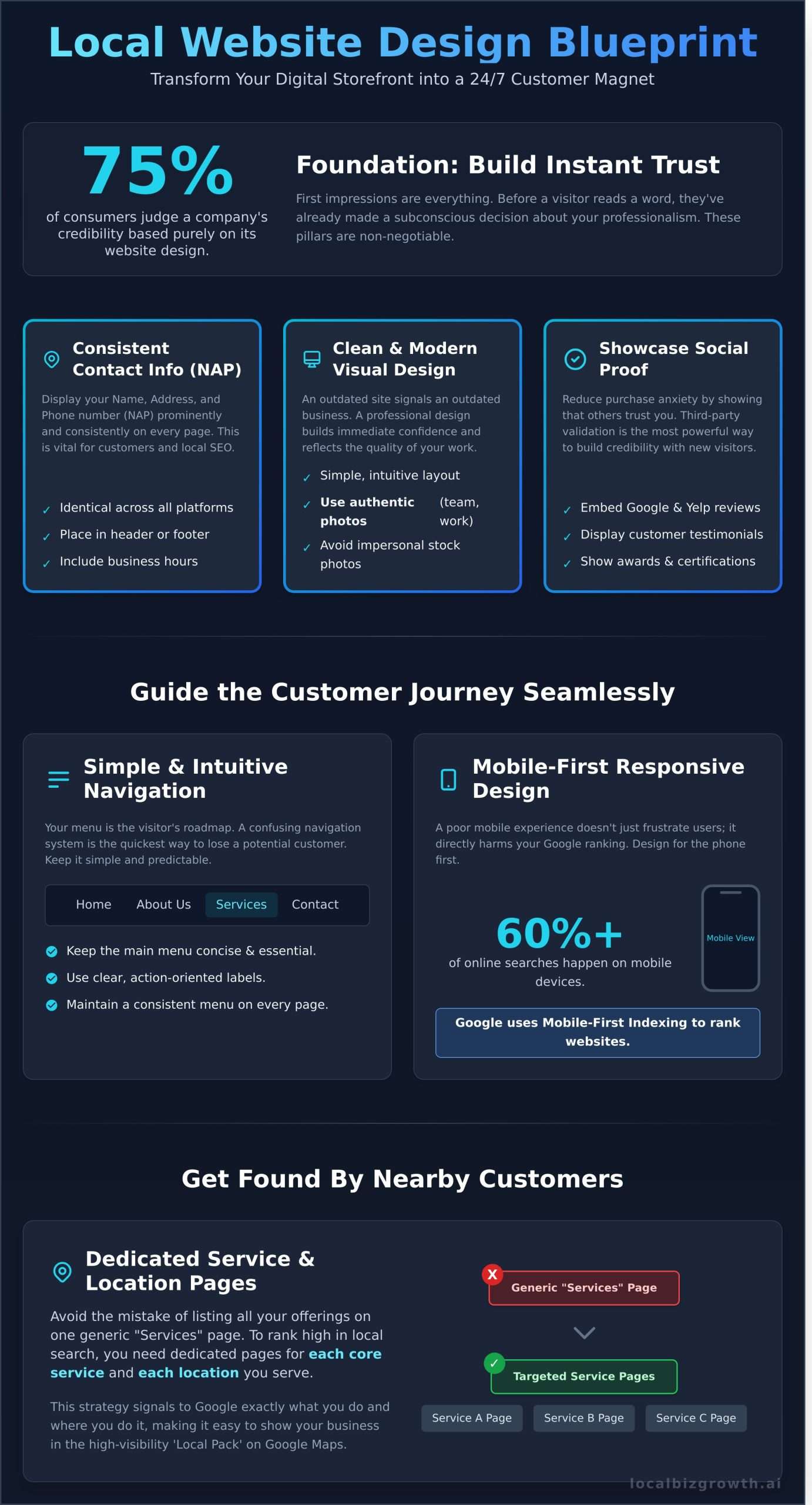
Your website is your digital storefront, and in the online world, first impressions are everything. Consider this: a staggering 75% of consumers admit to judging a company’s credibility based purely on its website design. Before a potential customer reads a single word about your services, they’ve already made a subconscious decision about your professionalism. This is why mastering foundational local business website design best practices isn’t just about looking good-it’s about building the instant trust required to convert a visitor into a lead.
To see these foundational elements in action, watch this helpful overview:
The following elements are non-negotiable for establishing credibility and turning a curious visitor into a loyal customer.
Prominent and Consistent Contact Information (NAP)
NAP stands for Name, Address, and Phone Number-the three most critical pieces of information for any local business. This data must be identical across your entire online presence and prominently displayed on every page of your website, typically in the header or footer. This consistency is vital not only for customers who need to find or call you but also for search engines like Google, which use it as a key local SEO ranking signal. Don’t forget to include your business hours to further build trust.
Professional, Clean, and Modern Visual Design
An outdated, cluttered website signals an outdated business. A modern, professional design builds immediate confidence. Focus on core web design principles: a simple, intuitive layout, clean and readable fonts, and consistent branding (logo, colors). Most importantly, use high-quality, authentic photos of your team, your location, and your work in action. Avoid generic stock photos, as they can feel impersonal and erode the very trust you’re trying to build.
Showcase Social Proof: Reviews and Testimonials
New customers are often hesitant. Social proof is the most effective way to reduce that purchase anxiety. Integrate glowing customer testimonials directly on your homepage and service pages. You can also use widgets to embed live, up-to-date reviews from trusted platforms like Google or Yelp. If you have industry awards, certifications, or have been featured in local media, display those logos proudly. This third-party validation tells visitors that others trust you, so they can too.
The Customer Journey: Guiding Visitors from Entry to Action
An effective local business website is far more than just a digital brochure; it’s a strategic tool designed to attract and convert customers. Great design isn’t measured by visual flair alone, but by its ability to provide a seamless user experience. The central goal is to create a frictionless path that guides a visitor from the moment they land on your site to the moment they take a desired action-whether that’s calling your office, filling out a form, or visiting your store. This user-centric approach is a core tenet of all local business website design best practices. When a potential customer is confused or frustrated, they don’t hesitate to leave. Your website’s structure must anticipate their needs and answer their questions intuitively, making it simple for them to accomplish their goals.
1. Simple and Intuitive Navigation
Your website’s main menu is the primary roadmap for your visitors. A cluttered or confusing navigation system is the quickest way to lose a potential lead. Keep it simple and predictable. Use clear, descriptive labels that your customers would actually search for-“Emergency Plumbing Services” is far more effective than a vague term like “Solutions.” Ensure this navigation bar is consistent on every single page to build familiarity and trust.
- Keep the main menu concise: Stick to essential pages like Home, About Us, Services, and Contact.
- Use clear, action-oriented labels: Clearly state what the user will find on each page.
- Maintain consistency: The menu should look and function the same across your entire site.
- Add a search bar: If your site has extensive content, like a blog or a large service list, a search bar is essential.
2. Mobile-First, Responsive Design
Today, your customers are searching for you on their phones. With over 60% of all online searches happening on mobile devices, a mobile-friendly website is non-negotiable. This is why one of the most critical local business website design best practices is implementing a responsive design, which automatically adapts its layout to fit any screen size. More importantly, Google uses mobile-first indexing, meaning it prioritizes the mobile version of your site for ranking. A poor mobile experience doesn’t just frustrate users; it directly harms your visibility in search results.
- Test for usability: Ensure buttons are large enough to tap easily and text is readable without pinching to zoom.
- Prioritize speed: Mobile users expect fast load times. Compress images and streamline code to boost performance.
- Think mobile-first: Design the mobile experience first, then adapt it for larger screens.
Built for Local Search: Getting Found by Nearby Customers
A visually stunning website is an excellent asset, but it generates zero ROI if local customers can’t find it. This is where design and local search engine optimization (SEO) must work together from day one. Effective local business website design best practices are fundamentally about signaling to search engines like Google exactly what you do and where you do it. The goal is to make it easy for Google to feature your business in the high-visibility ‘Local Pack’ and on Google Maps when a nearby customer needs your services.
6. Dedicated Pages for Each Service and Location
Avoid the common mistake of listing all your offerings on a single, generic “Services” page. To effectively attract high-intent customers, create a unique page for each core service you provide. For example, a plumber should have separate pages for ‘Residential Plumbing Services,’ ‘Emergency Drain Cleaning,’ and ‘Water Heater Installation.’ This strategy allows you to rank for specific search queries. If you operate in multiple towns or have several physical storefronts, each location must have its own dedicated page complete with its unique Name, Address, and Phone number (NAP).
7. Strategic Use of Local Keywords
Your content needs to speak the language of your local customers. Integrate location-based keywords naturally into your page titles, headings, and body text. Think like your customer: they search for terms like “best pizza in downtown Miami” or “emergency electrician near me.” Writing content that answers common local questions is a powerful strategy. This approach aligns with many expert-recommended small-business website best practices because it directly addresses user intent and builds topical authority. Not sure about SEO? Local Biz Growth builds websites designed to rank locally.
8. Integration with Google Business Profile
Your Google Business Profile (GBP) is your most powerful local SEO asset, and your website should be tightly integrated with it. This creates a loop of trust and consistency for Google. Key actions include:
- Embedding a Google Map of your physical location on your ‘Contact Us’ page.
- Placing a direct link on your site that encourages customers to leave a review on your GBP listing.
- Ensuring your website URL is listed correctly and consistently on your GBP dashboard.
These simple steps reinforce your location and credibility, creating a powerful and consistent signal that helps Google confidently recommend your business to local searchers.
The Conversion Engine: Turning Clicks into Customers
A visually appealing site is a great start, but the most effective local business website design best practices focus on one primary goal: conversion. Every headline, image, and button should work in concert to guide a visitor toward taking a specific, valuable action. This is the critical stage where thoughtful design translates directly into new leads, phone calls, and revenue for your business. The objective is to make it incredibly easy and intuitive for a potential customer to get in touch.
9. Clear and Compelling Calls-to-Action (CTAs)
You must tell your visitors exactly what you want them to do next. A Call-to-Action (CTA) is a prompt-usually a button or a link-that encourages immediate response. Vague CTAs like ‘Click Here’ are ineffective. Instead, your strategy should be direct and benefit-driven.
- Use action-oriented language: Start with a strong verb. “Get a Free Quote,” “Schedule Your Consultation,” or “Download Our Guide” are clear and compelling.
- Make CTAs visually distinct: Use a bold, contrasting color for your CTA buttons so they stand out from the rest of the page content.
- Place them strategically: Position CTAs “above the fold” on your homepage and after key sections of content where a user might be ready to act.
- Ensure every page has a purpose: No page should be a dead end. Guide the user with a clear next step, whether it’s to contact you, view services, or read a related blog post.
10. Frictionless Contact Forms
When a visitor decides to contact you, any obstacle can cause them to abandon the process. Keep your contact forms as simple and streamlined as possible to maximize lead capture. Only ask for the absolute essentials needed to start a conversation-typically a name, email or phone number, and a brief message. Ensure your forms are large and easy to use on mobile devices, and always display a clear confirmation message like “Thank you! We’ll be in touch shortly” after a successful submission. Most importantly, never hide your phone number in favor of a form; give customers the choice to connect in the way they prefer.
11. Click-to-Call and Click-to-Map Functionality
For local businesses, a significant portion of website traffic comes from users on mobile devices who are often ready to take immediate action. Removing barriers for these high-intent visitors is paramount. Make your phone number a clickable link (using a <a href="tel:..."> tag) so users can call you with a single tap. Similarly, your physical address should link directly to Google Maps or Apple Maps, making it effortless for customers to get directions. These small technical details are non-negotiable for modern local websites and can dramatically improve your conversion rates.
By implementing these conversion-focused strategies, you transform your website from a passive digital brochure into an active engine for growth. At Local Biz Growth, we build websites designed not just to attract visitors, but to convert them into your next loyal customers.
Turn Your Website Into a Customer-Generating Machine
An effective website is your most powerful tool for attracting local customers. It’s not just about looking good; it’s about building instant trust and guiding visitors on a clear journey from discovery to action. Implementing these local business website design best practices is the crucial difference between a site that simply exists and one that actively grows your bottom line by getting you found in local searches and converting clicks into real business.
Putting all the pieces together requires expertise. At Local Biz Growth, we deliver proven results for local businesses across the US. Our AI-powered strategies are designed to maximize your leads, and our confidence is backed by our results-based model-with no long-term contracts. We simplify the entire process so you can focus on what you do best.
Ready for a website that gets results? Get your free consultation today!
Your next customer is searching online right now. Let’s make sure they find you.
Frequently Asked Questions About Local Business Website Design
How much should a website for a local business cost?
The cost for a local business website can range from a few thousand dollars for a professional template-based site to over $10,000 for a fully custom solution. It’s best to view this as an investment in your primary customer acquisition tool. The final price depends on your specific goals and required features, like e-commerce or booking systems. A well-designed site should always be focused on generating a strong return on investment by attracting and converting new customers.
Can I just use a Facebook page instead of a website?
While a Facebook page is a valuable marketing channel, it should not replace a professional website. You don’t own your social media profile; the platform controls your reach and can change its rules at any time. A dedicated website is an asset you control completely, establishing credibility and acting as the central hub for your marketing efforts. It is also far more effective for search engine optimization (SEO), ensuring local customers find you when they are ready to buy.
How long does it take to design and launch a new local business website?
A standard local business website typically takes 4 to 8 weeks from our initial strategy session to launch. This timeline allows for a proven process that includes design, content creation, development, and thorough testing. More complex projects with custom features or extensive e-commerce functionality may require more time. Our focus is on getting your effective, lead-generating website online efficiently without compromising on the quality needed to grow your business.
Do I need a blog on my local business website?
Yes, a blog is a powerful tool for attracting local customers. By consistently publishing content that answers common questions related to your services, you establish your business as a trusted local authority. This strategy significantly improves your website’s SEO, making it easier for potential customers to find you on Google. Each blog post is a new opportunity to connect with your audience, generate qualified leads, and drive measurable business growth.
What’s the difference between a custom website and a template site like Squarespace?
Template sites offer a fast, low-cost way to get online using pre-made designs, but they can be very restrictive. A custom website is built from the ground up to meet your specific business goals. It allows for a unique brand experience, superior performance, and is optimized to convert visitors into leads. Following local business website design best practices with a custom build provides a scalable foundation that delivers a much higher long-term return on investment.
How do I measure if my website is actually helping my business?
We measure a website’s success with key performance indicators (KPIs) that directly impact your bottom line. This includes tracking the number of contact form submissions, phone calls generated from the site, and online bookings or sales. Using tools like Google Analytics, we monitor traffic, user behavior, and search rankings. This data-driven approach shows a clear ROI and allows us to continuously optimize your site to attract more customers and grow your revenue.