
Thinking about using Google Ads to attract more customers but worried about the cost? You’re not alone. For many owners, the fear of pouring money into a complex platform with no guaranteed return is a major roadblock. The question of how much do Google Ads cost for a small business is one of the most common-and most confusing-in digital marketing, often clouded by technical jargon and vague estimates that leave you feeling more uncertain than when you started.
We’re here to give you clear, actionable answers. This 2026 guide provides a no-fluff breakdown of the real-world costs you can expect. We will demystify everything from your daily ad spend and average cost-per-click to the difference between your budget and potential agency management fees. By the end, you’ll not only understand how to set a smart budget that attracts new customers and generates a positive ROI, but you’ll also have the confidence to decide if this powerful tool is the right investment to grow your business.
Key Takeaways
- Your total Google Ads investment is always split into two parts: the ad spend paid directly to Google and the separate management fee for expert campaign oversight.
- Discover why the highest bidder doesn’t always win and how factors like your Quality Score directly impact the actual price you pay for each click.
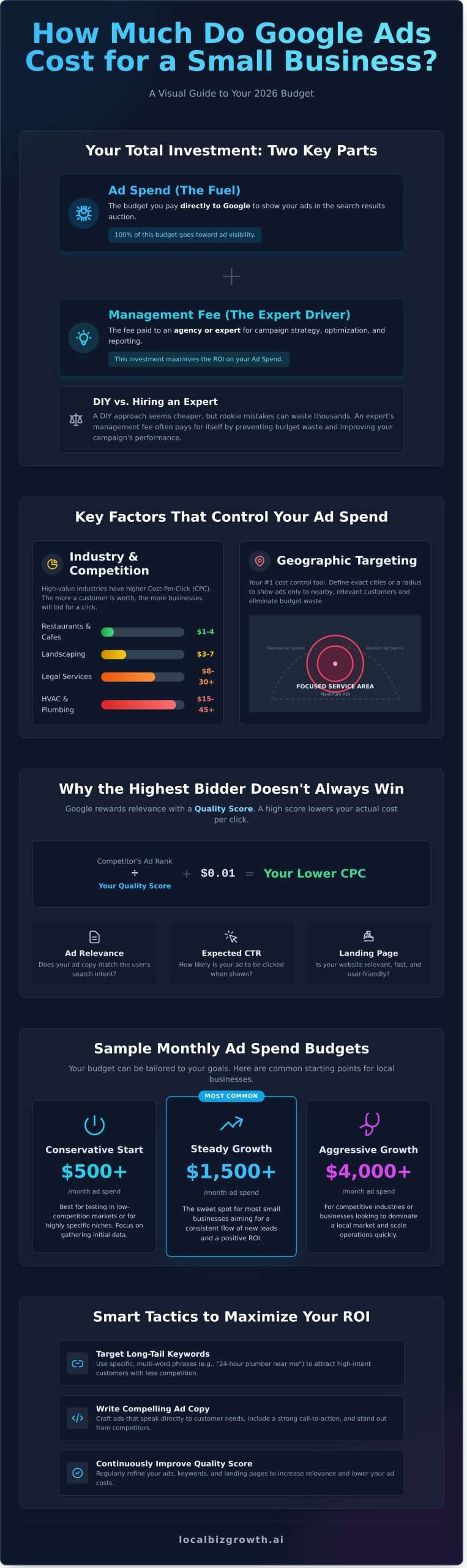
- We break down how much Google Ads cost for small business with real-world budget examples, from conservative starting points to aggressive growth campaigns.
- A smart strategy is more important than a huge budget. Learn actionable tactics to maximize your Return on Investment (ROI) and attract high-quality local customers.
The Two Parts of Your Google Ads Cost: Ad Spend vs. Management Fees
When local business owners ask, “how much do google ads cost for small business,” the most common point of confusion is thinking it’s a single, all-inclusive price. The reality is that your total investment is always split into two distinct and equally important categories. To simplify this, think of it like operating a high-performance vehicle: one cost is the fuel, and the other is for the expert driver who knows how to win the race.
This video provides an excellent overview of the factors that influence your costs:
What is Ad Spend? (The Fuel You Pay Google)
Your Ad Spend is the budget you pay directly to Google. Think of this as the fuel for your marketing engine. This budget is entered into the vast, real-time auction that powers Google Ads, where you bid against competitors for clicks on specific keywords relevant to your business. You have complete control over this amount and can set a daily maximum to ensure you never overspend. Crucially, 100% of this budget goes directly toward showing your ads to potential customers.
What are Management Fees? (The Expert Driver)
The management fee is what you pay a professional agency or freelancer to be the expert driver of your campaign. This fee covers the essential, results-driven work required for success: strategic campaign setup, continuous monitoring, performance optimization, and detailed reporting. The primary goal of management is to maximize the ROI on your Ad Spend. It’s an investment in expertise designed to prevent you from wasting your ad budget and to ensure every dollar works harder to attract new leads and grow your business.
DIY vs. Hiring an Agency: A Cost-Benefit Analysis
While a DIY approach seems cheaper upfront, the Google Ads platform has a steep learning curve. Without expertise, it’s incredibly easy to waste thousands of dollars on rookie mistakes like bidding on the wrong keywords, writing ineffective ad copy, or failing to track conversions. An expert agency’s management fee often pays for itself by saving you money in the long run. We find more cost-effective keywords, improve your ad performance to lower your cost-per-click, and ultimately generate a higher return on your total investment.
Key Factors That Determine Your Google Ad Spend
While there’s no single price tag for a successful campaign, the most empowering part of Google Ads is that you have significant control over your budget. The answer to “how much do google ads cost for small business” depends directly on strategic choices you can make. Understanding these key variables puts you in the driver’s seat, allowing you to build an effective campaign that generates a strong return on investment (ROI).
Let’s break down the core factors you can influence to manage your ad spend effectively.
Industry & Keyword Competition
Google Ads operates like a live auction. You bid against your competitors for specific keywords that potential customers are searching for. The cost-per-click (CPC) is determined by demand. A keyword with high commercial intent, like “emergency plumber in Miami,” will cost significantly more than “local bakery menu” because a single plumbing job is worth thousands of dollars. Industries like law, insurance, and home services (HVAC, plumbing) are notoriously competitive, leading to higher CPCs.
A proven strategy to manage this is to target less competitive, long-tail keywords (e.g., “tankless water heater installation” instead of just “plumber”). For a personalized projection, the official Google Ads cost estimator provides data-backed benchmarks for your specific industry and location. Here are some sample CPC ranges for local businesses:
- Restaurants & Cafes: $1.00 – $3.50 per click
- Local Retail / Boutiques: $1.50 – $4.00 per click
- Landscaping Services: $3.00 – $7.00 per click
- Legal Services (Family Law, PI): $8.00 – $30.00+ per click
- HVAC & Plumbing: $15.00 – $45.00+ per click
Geographic Targeting: Your #1 Cost Control Tool
For a local business, this is your superpower. Geographic targeting allows you to define the exact cities, postal codes, or even a mileage radius around your business where your ads will appear. This is the most effective way to eliminate budget waste. Instead of paying for clicks from someone 100 miles away, you ensure every dollar is spent reaching potential customers who can actually hire you. A tightly focused 10-mile radius campaign for a local pizzeria will be far more cost-effective and generate a better ROI than a statewide one.
Ad Scheduling & Device Targeting
Your business likely has specific operating hours, and your ads can, too. You don’t need to run them 24/7. Ad scheduling allows you to show ads only during the times and days you’re most likely to attract customers. A restaurant can run ads from 11 AM-2 PM for the lunch rush and 5 PM-9 PM for dinner. Conversely, an emergency service might bid more aggressively on nights and weekends when demand is highest. You can also adjust bids for users on mobile devices versus desktops, another layer of control to optimize your spend.
How Google Calculates Your Actual Price: A Simple Guide
When business owners ask “how much do google ads cost for small business,” they often assume it’s a simple auction where the highest bidder wins. The reality is more strategic and, frankly, better for businesses that focus on quality. Google’s system is designed to reward advertisers who provide the most relevant and helpful experience for searchers. This means you don’t need the deepest pockets to succeed; you need a smarter, more effective strategy.
Understanding this system is the first step toward building a campaign that delivers a strong return on investment. It’s not about outspending the competition-it’s about outsmarting them.
Quality Score Explained: Google’s Reward System
Think of Quality Score as Google’s “relevance” grade for your ad, rated on a scale of 1 to 10. It’s a powerful metric that measures how well your keyword, ad copy, and landing page align with what a user is searching for. A high score tells Google your ad is a great match. The direct benefit for your business is clear: a higher Quality Score leads to lower ad costs and better ad positions. It’s Google’s way of ensuring its users find exactly what they need, and they reward you for helping them do it.
Ad Rank: How You Win the Ad Spot
Your ad’s position on the search results page isn’t determined by your bid alone. It’s decided by a metric called Ad Rank. The formula is simple yet powerful:
Ad Rank = (Your Maximum Bid) x (Your Quality Score)
This formula is a game-changer. It proves that a well-optimized campaign can outperform a competitor with a much larger budget. Let’s look at a practical example:
- Competitor A (Big Budget): They bid $4.00 per click but have a low Quality Score of 3/10. Their Ad Rank is 12 (4 x 3).
- Your Business (Smart Budget): You bid only $2.50 per click but have an excellent Quality Score of 10/10. Your Ad Rank is 25 (2.5 x 10).
In this scenario, your business wins a better ad position while paying significantly less per click. This is the core principle for managing Google Ads costs effectively. By focusing on relevance and quality, you directly influence how much Google Ads cost for your small business, turning your marketing budget into a powerful tool for growth.
Realistic Monthly Budgets for Local Small Businesses
Theory is helpful, but you need real numbers. So, how much do Google Ads cost for small business owners in the real world? While every market is different, most successful local campaigns fall into one of three budget tiers. Think of these as proven starting points that can be scaled as you see a positive return on investment.
These scenarios are designed to give you a tangible framework for planning your advertising spend and setting realistic expectations for growth.
Starting Out: The $500 – $1,000 per Month Budget
This is an excellent entry point for businesses testing the waters or operating in a low-competition niche. The strategy here is hyper-focused on a small geographic area and a handful of your most profitable services to maximize every dollar.
- Good For: A single-operator handyman, a local coffee shop promoting a new special, or a new tutoring service.
- Goal: Generate a handful of initial leads, gather critical performance data, and prove the concept before scaling up.
Steady Growth: The $1,000 – $2,500 per Month Budget
This is the most common and effective range for established small businesses seeking a reliable stream of new customers. This budget provides enough flexibility to expand your service area, target a wider set of valuable keywords, and consistently appear in front of potential customers every day.
- Good For: A dental practice, a small roofing company, or an independent insurance agent.
- Goal: Achieve a consistent, predictable flow of daily leads and phone calls, becoming a well-known option in your local market.
Aggressive Growth: The $2,500+ per Month Budget
For businesses in highly competitive markets or those aiming for rapid expansion, a more aggressive budget is required. This level of investment allows you to bid on the most expensive, high-intent keywords and outrank competitors for the most lucrative jobs.
- Good For: A personal injury law firm, a multi-van plumbing company, or a high-end home remodeling contractor.
- Goal: Dominate the local market for your core services and significantly increase market share.
Remember, the right budget is the one that aligns with your specific business goals. At Local Biz Growth, we help you build a custom strategy designed to deliver a clear and measurable return on your investment.
How to Maximize Your ROI and Avoid Wasting Your Budget
The conversation around Google Ads often starts with cost, but successful businesses focus on return on investment (ROI). A large budget spent inefficiently will always underperform a smaller, strategically managed budget. The real answer to how much do google ads cost for small business is directly tied to the effectiveness of your strategy. A well-executed campaign doesn’t cost you money; it makes you money. Here are the essential, non-negotiable strategies to ensure every dollar you spend works to grow your business.
Focus on Conversion Tracking, Not Just Clicks
Paying for clicks is easy; paying for results is smart. A click that doesn’t lead to a new customer is a wasted expense. That’s why conversion tracking is the absolute foundation of any profitable campaign. We define a conversion as a valuable action a user takes-like a phone call, a contact form submission, or a direct purchase. This is the only way to measure your true ROI and make data-driven decisions. It’s the first thing an expert puts in place.
Use Negative Keywords to Eliminate Bad Clicks
One of the fastest ways to stop wasting money is by telling Google which searches not to show your ads for. These are called negative keywords. For example, a plumber offering emergency repairs should add negative keywords like “-jobs,” “-training,” and “-free” to avoid paying for clicks from job seekers or people looking for DIY tutorials. Continuously refining this list is a simple but powerful tactic to improve ad relevance and protect your budget.
Invest in a High-Converting Landing Page
Sending your valuable, paid ad traffic to your generic homepage is a costly mistake. A potential customer who clicks your ad needs a clear, direct path to action, not a maze of navigation options. A dedicated landing page with a single, compelling call-to-action (CTA) is essential. It removes distractions and guides the user to convert. A better user experience also improves your Google Quality Score, which can directly lower your cost-per-click (CPC).
Ultimately, a successful Google Ads campaign is a system where every component-from keywords to landing pages-works together to attract and convert customers. It transforms your advertising from an expense into a predictable engine for growth. If you’re ready to move beyond guessing games, let us build a strategy that turns clicks into customers.
Turn Your Google Ads Budget into Real Business Growth
Ultimately, the answer to how much do google ads cost for small business is less about a fixed price and more about strategic investment. As we’ve covered, your total cost is a combination of your ad spend and management, influenced by factors like your industry and location. The most important takeaway is that a well-managed campaign is the key to maximizing your return on investment and avoiding wasted dollars.
You don’t have to navigate this complex landscape alone. At Local Biz Growth, we use proven strategies and AI-powered targeting to ensure your budget is invested effectively, attracting high-quality customers ready to convert. We’re so confident in our results-based model that we don’t require long-term contracts. Our success is tied directly to your growth.
Ready to stop guessing and start growing? Discover what a professionally managed campaign can do for your bottom line. Get a Free, No-Obligation Google Ads Consultation Today!
Frequently Asked Questions
Is there a minimum ad spend required by Google Ads?
No, Google does not enforce a minimum ad spend. You have complete control and can set a daily budget that fits your business. However, to generate meaningful results and attract qualified customers, a strategic budget is essential. An extremely low budget may not gather enough data for optimization or reach a significant audience. Local Biz Growth helps its clients determine an effective starting budget that aligns with their growth goals to ensure a positive return on investment.
How long does it take for a small business to see results from Google Ads?
You can start seeing traffic and initial leads within days of launching a campaign. However, achieving consistent, profitable results takes time. The first few weeks are crucial for gathering data and optimizing for conversions. Most businesses begin to see a stable and positive ROI within 1-3 months as Local Biz Growth refines the strategy. Its focus is on building a campaign that delivers sustainable growth, turning valuable leads into your loyal customers.
What is a good Cost Per Lead (CPL) for a local business?
A good Cost Per Lead (CPL) varies significantly by industry and location. For example, a local plumber might aim for a CPL of $20-$40, while a competitive field like law could see CPLs over $150. The most important metric is your return on investment; the right CPL is one that allows your business to remain highly profitable. Local Biz Growth analyzes your specific customer value to establish a target CPL that drives real growth for your business.
What makes Google Ads effective for a local service business?
Google Ads is exceptionally powerful for local service businesses because it captures high-intent leads – people actively searching for your services right now. This direct targeting often leads to faster conversions and a quicker return on investment. For most local service businesses, Local Biz Growth recommends focusing on Google Ads to capture immediate demand and maximize ROI from active searchers, ensuring your budget connects with customers ready to buy.
Can I pause my Google Ads campaigns at any time?
Yes, you have complete flexibility to pause and resume your Google Ads campaigns at any time with no penalties. This control is ideal for managing your budget, responding to seasonal demand, or if you become too busy to handle new leads. Local Biz Growth believes in providing its clients with effective solutions that adapt to the real-world needs of their business. You are always in control of your advertising spend, and Local Biz Growth manages the strategy to maximize its impact.
Do I pay if someone clicks my ad multiple times?
Google has a sophisticated system to filter out invalid clicks, including most repeated clicks from the same user. You are not charged for these clicks, ensuring your budget is spent on attracting genuine customers. When determining how much do google ads cost for small business, it’s reassuring to know these protective measures are in place. Local Biz Growth’s expert campaign management includes monitoring for any unusual activity to further protect your investment and maximize your ROI.