
As a local business owner, you know the goal is simple: get your phone to ring with qualified customers. Yet, navigating Google’s ever-changing ad platforms can feel anything but simple. You see competitors with that powerful ‘Google Guaranteed’ badge and wonder how to get that same level of trust for my local services. The confusion around different ad types and the seemingly complex verification process can be enough to stop you before you even start, leaving you to question if these ads are truly cost-effective for your business.
This guide is here to change that. We are pulling back the curtain on Google’s powerful lead generation tool, Local Service Ads. In this complete 2026 walkthrough, we will demystify the entire platform, providing a clear, step-by-step roadmap. You’ll learn exactly how to become ‘Google Guaranteed’, determine if your business is eligible, and finally start generating a predictable stream of high-quality leads directly from the very top of search results. It’s time to convert more local customers.
What Are Google Local Service Ads (And Why They’re Not a Directory)
Many business owners search for “my local services” when looking for ways to dominate their local market, often confusing Google’s most powerful advertising tool with a simple directory listing. Let’s clarify: Google Local Service Ads (LSAs) are not a directory. They are a premium, trust-focused advertising system designed to connect verified local businesses with customers actively seeking their services. These ads appear at the absolute top of Google search results-above traditional ads, map packs, and organic listings-giving you immediate visibility and credibility.
To see exactly how these ads function and where they appear, watch this brief overview:
The ‘Google Guaranteed’ Badge: Your Ultimate Trust Signal
The core of LSAs is the trust badge. The Google Guaranteed badge shows customers you’ve passed Google’s background and license checks. It even includes a customer satisfaction guarantee, covering jobs up to $2,000 in the US. For professional services like law and real estate, the Google Screened badge serves a similar purpose, verifying licenses and background checks to build instant confidence with potential clients.
Who Can Use Local Service Ads? Eligible Industries
While Google is constantly expanding its list, LSAs are currently available for a wide range of home and professional service providers. Common eligible industries include:
- Home Services: Plumbers, HVAC technicians, electricians, roofers, house cleaners, and locksmiths.
- Professional Services: Lawyers (in specific practice areas), real estate agents, and financial planners.
Even professional services with a niche, international clientele can benefit from this targeted advertising. For example, you can learn more about Israel Cross Border Law Firm, which uses digital strategies to reach clients in both the United States and Israel.
Eligibility can be location-specific, so it’s essential to check availability in your service area.
How the Pay-Per-Lead Model Works
Here’s the key differentiator: you pay per lead, not per click. Unlike the traditional pay-per-click (PPC) model common across the broader Google Ads platform, with LSAs you only pay when a potential customer initiates contact through a phone call, message, or booking request directly from your ad. If you receive an invalid lead-such as a wrong number or a solicitor-you can easily dispute it and receive a credit, ensuring your marketing budget is spent only on attracting real customers.
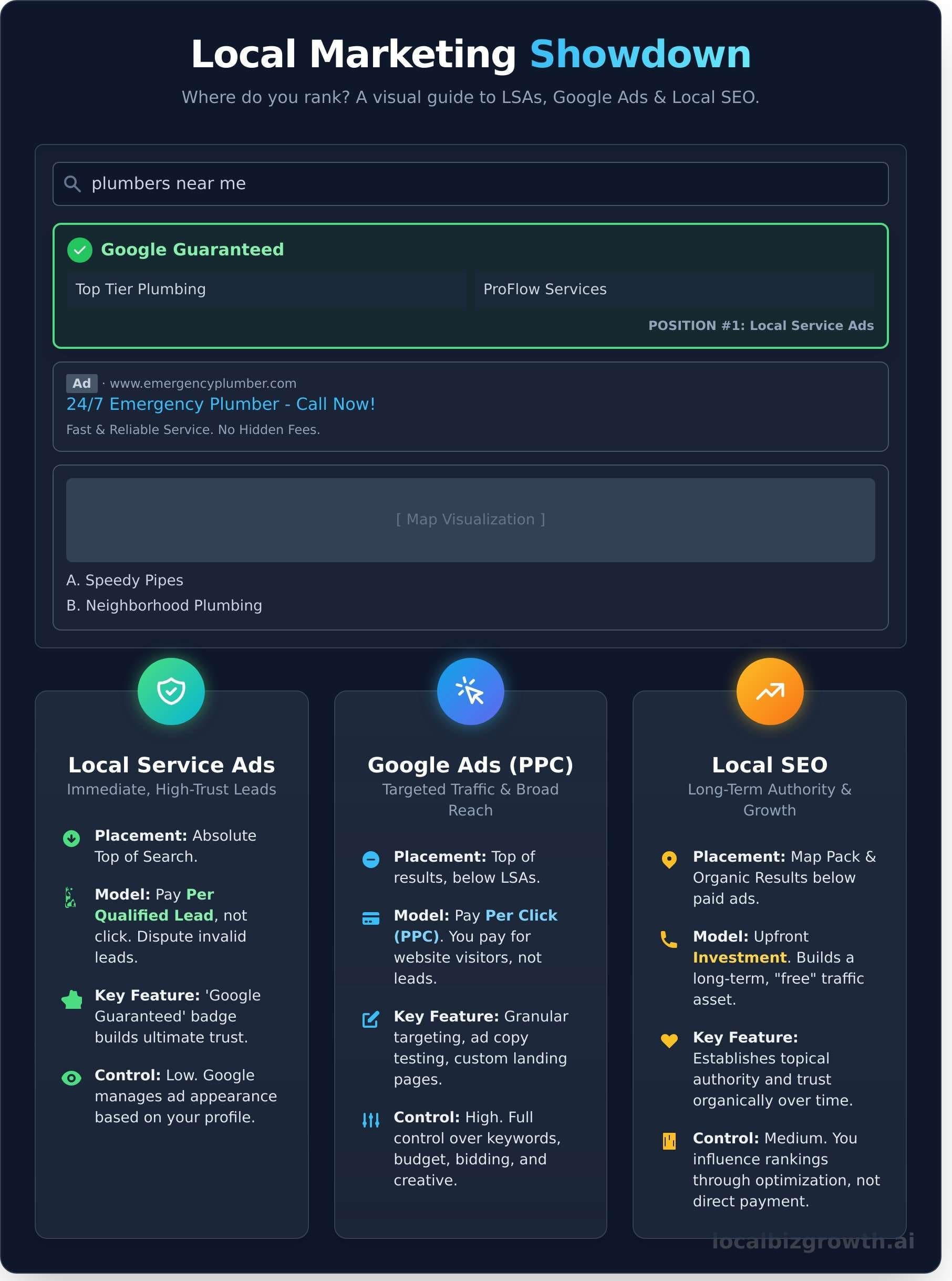
LSAs vs. Google Ads vs. Local SEO: Choosing Your Strategy
When potential customers search for local services online, where do you want your business to appear? This isn’t just a marketing question; it’s a core strategic choice. Understanding the difference between Local Services Ads (LSAs), traditional Google Ads, and Local Search Engine Optimization (SEO) is critical to investing your budget effectively and achieving sustainable growth.
While each has unique strengths, the most powerful approach often combines all three. To simplify the decision, think of it this way: paid ads are like renting a highly visible billboard on a busy highway. They get you immediate attention, but you only stay there as long as you pay. SEO is like buying the land and constructing your own building. It’s an investment that takes time, but it becomes a valuable asset you own, attracting customers organically for years to come.
| Feature | Local Services Ads (LSAs) | Google Ads (PPC) | Local SEO |
|---|---|---|---|
| Payment Model | Pay-per-Qualified-Lead | Pay-per-Click (PPC) | Upfront Investment |
| Primary Goal | Immediate, High-Trust Leads | Targeted Traffic & Testing | Long-Term Authority & Growth |
| Control Level | Low (Google-managed) | High (Granular Targeting) | Medium (Influence Rankings) |
Cost & Payment Model: Lead vs. Click
With LSAs, you pay for results-qualified leads from customers seeking your services. This direct ROI is compelling. In contrast, Google Ads operates on a pay-per-click model, where you pay for website visitors, offering broad reach but no guarantee of conversion. SEO is a strategic investment in your digital assets. It requires upfront work but builds a “free” traffic engine that lowers your customer acquisition cost over time.
Control & Targeting Capabilities
True to their name, Google Local Services Ads are simple, offering limited control over ad copy but building immense trust with the “Google Guaranteed” badge. Traditional Google Ads provide maximum control, allowing you to target specific demographics, test creative messaging, and direct users to custom landing pages. SEO casts the widest net, helping you rank for countless search queries related to my local services and establishing your business as a topical authority.
How They Work Together for Local Dominance
A truly dominant strategy doesn’t choose one; it integrates all three. LSAs secure immediate, high-trust visibility at the very top of the page. Google Ads can fill ranking gaps, promote a special offer, or target a niche customer segment. All the while, your SEO efforts work tirelessly in the background, building a powerful, long-term foundation that reduces your reliance on paid advertising and drives consistent, high-quality leads to your business.
The Path to Google Guaranteed: A Step-by-Step Vetting Process
Earning the Google Guaranteed badge is a powerful way to build immediate trust with potential customers. Think of this process not as a hurdle, but as a strategic checklist to prove your business is a legitimate, high-quality provider. Google’s vetting is designed to protect consumers, which in turn rewards you with high-visibility placement and more qualified leads. While the entire process can take several weeks, the investment in time is a direct investment in your brand’s credibility.
Step 1: Confirm Your Eligibility and Sign Up
Your first move is to confirm your business category and location are eligible. Google provides an official Local Services Ads sign-up page where you can check your status instantly. Once confirmed, you will create your LSA profile. Be prepared with the following information, and ensure it is 100% accurate as it appears on your official business documents:
- Your business name, address, and phone number
- Your service area (by city, county, or zip code)
- Your business hours and services offered
- Your business registration details
Step 2: Complete the Background Check
To protect homeowners, Google requires background checks for the business owner and, in some cases, all employees who perform services at a customer’s location. This process is managed by a trusted third-party partner, such as Pinkerton. You will be asked to provide personal information, including a social security number for US-based owners, to complete this confidential check. This step is non-negotiable and is fundamental to the trust the Google Guaranteed badge represents.
Step 3: Submit Proof of License and Insurance
Finally, you must demonstrate that your business is professionally compliant. This involves submitting current copies of your state, provincial, or county business licenses. You will also need to provide a certificate of insurance showing you carry general liability coverage. While requirements can vary by industry, a minimum of $2 million in aggregate coverage is a common benchmark. This ensures that when a customer searches for and books my local services through the platform, they are choosing a fully protected and professional company.
Pro Tip: To avoid delays, ensure the business name and address on your insurance and license documents precisely match the information you entered in your LSA profile.
Navigating these requirements is a critical step toward unlocking a new stream of high-intent customers. If you need expert guidance to streamline the application process, the team at Local Biz Growth is here to help you get it right the first time.
Optimizing Your LSA Profile for Maximum Leads
Securing your Google Screened badge is a fantastic first step, but it’s only the beginning. To truly dominate your local market and generate a consistent flow of high-quality leads, you must actively manage and optimize your Local Services Ads profile. Unlike traditional ads, LSA performance is heavily influenced by your real-world business practices, especially your responsiveness and customer satisfaction. A ‘set it and forget it’ approach will leave you falling behind competitors who are actively working to win Google’s favor.
Managing Your Budget and Bidding
Your budget directly controls your lead potential. Start by setting a weekly budget based on the number of leads you can comfortably handle. From there, Google offers two primary bidding strategies:
- Maximize leads: This automated option lets Google’s AI adjust your bids to get you the most possible leads within your budget. It’s ideal for businesses focused on aggressive growth.
- Set max per lead: This gives you more control by setting a price ceiling for each lead. Use this when you have a strict cost-per-acquisition target, but be aware it may limit your ad’s visibility.
Responding to Leads and Booking Jobs
Responsiveness is arguably the most critical ranking factor in the LSA ecosystem. Google rewards businesses that answer calls and reply to messages promptly. Failing to do so can quickly diminish your ad’s ranking. After you secure a customer, immediately mark the lead as ‘booked’ in your LSA dashboard. This action sends a powerful positive signal to Google, confirming that you are an active, reliable provider who converts leads into actual jobs.
The Power of Reviews in the LSA Ecosystem
Reviews build trust, but for LSAs, not all reviews are created equal. Only reviews from verified customers who booked you through the LSA platform count toward your ad ranking. After completing a job, use the LSA dashboard to send a direct review request to your client. Consistently earning high-star ratings is essential for attracting clicks and proving to both Google and potential customers that you deliver quality results for my local services.
When to Hire an Agency to Manage Your Ads
Managing an LSA profile effectively requires consistent attention. For busy owners, partnering with an expert agency can simplify the process and significantly boost your return on investment. An agency provides:
- Expert Optimization: Strategic bid and budget management to maximize lead quality and volume.
- Time Savings: We handle lead disputes, review requests, and profile updates so you can focus on your work.
- Improved ROI: A professionally managed campaign ensures your ad spend is working as efficiently as possible.
Stop guessing what works and start getting results. Let our AI-powered approach maximize your local ad results.
Turn Trust into Customers with Local Service Ads
As we’ve covered, Google Local Service Ads are far more than a simple directory; they are a powerful engine for generating high-intent leads. The key takeaways are clear: the Google Guaranteed badge is your ultimate trust signal, a well-optimized profile is your best tool for conversion, and this platform is essential for local growth. Mastering your strategy for my local services ads means you connect directly with customers at the very moment they need you, putting you ahead of the competition.
But getting started and maximizing your return on investment requires a dedicated strategy. At Local Biz Growth, we simplify the entire process. Our experts leverage AI-powered targeting to stretch your ad budget further and implement proven strategies designed to attract high-quality local leads that convert. We’re so confident in our ability to deliver that we operate without long-term contracts-our focus is purely on generating measurable results for your business.
Ready to get Google Guaranteed? Talk to our local ads experts today! Your next loyal customer is out there. Let’s help them find you.
Frequently Asked Questions About Local Service Ads
How much does a lead from a Google Local Service Ad cost?
The cost of a lead from a Google Local Service Ad (LSA) operates on a pay-per-lead basis, not pay-per-click. This means you only pay for valid customer inquiries. Prices can range from $6 to over $30 per lead, depending heavily on your industry and geographic location. For instance, a lead for a locksmith in a major metropolitan area will typically cost more than a lead for a house cleaner in a suburban town, reflecting the job’s potential value.
What’s the difference between a Google Business Profile (GBP) and a Local Service Ad?
A Google Business Profile is a free tool to manage your online presence across Google, including Search and Maps, and is crucial for local SEO. In contrast, Local Service Ads are paid advertisements that appear at the very top of search results, above traditional ads and organic listings. LSAs also come with the prestigious Google Guaranteed badge, which builds immediate trust with potential customers and requires a more rigorous verification process than a standard GBP listing.
How long does it take to get approved and become Google Guaranteed?
The approval process to become Google Guaranteed typically takes between two to five weeks. The timeline depends on how quickly you can submit the required documentation, which includes business license verification, proof of insurance, and background checks for you and your field employees. Completing these steps promptly is key to a faster approval. Once verified, your ads can go live, showcasing the green checkmark that builds significant customer trust and generates higher-quality leads.
What happens if I get a bad or irrelevant lead from my LSA?
Google provides a straightforward process for handling irrelevant leads. If you receive a lead that is spam, a sales call, for a service you don’t offer, or from a customer outside your designated service area, you can dispute it directly within your LSA dashboard. If Google verifies the lead as invalid according to their policies, the cost of that lead is credited back to your account. This ensures you only pay for genuine opportunities to grow your business.
Can I run Local Service Ads and traditional Google Ads at the same time?
Absolutely. Running both Local Service Ads and traditional Google Ads simultaneously is a powerful strategy for maximizing your visibility. LSAs capture high-intent customers at the very top of the page who are ready to book. Google Ads offer more control over keywords and ad copy, allowing you to reach customers at different stages of the buying journey. Using both ensures you dominate search results and attract the widest possible audience for my local services.
Do I need a website to use Google Local Service Ads?
While a professional website is highly recommended for building credibility, it is not a strict requirement to run Google Local Service Ads. Your LSA links to a dedicated profile page hosted by Google that contains your reviews, business hours, and services. This profile is often sufficient to convert leads. However, a well-designed website can provide more in-depth information and further convince customers to choose my local services over competitors, increasing your overall conversion rate.