
Are you a local business owner looking to attract more nearby customers, make your phone ring, and drive more foot traffic through your doors? Google’s powerful advertising tools can connect you with potential customers in your immediate area, right when they’re searching for your products or services. This guide will teach you how to use Google Ads effectively to grow your local business.
What is Google Local Advertising?
Simply put, Google local advertising is a strategy that shows your ads only to potential customers within a specific geographic area you define. Instead of advertising to the entire country, you focus your budget on the neighborhoods, cities, or regions you actually serve. The primary goal is to connect you with people actively searching for your services nearby, driving valuable actions like phone calls, store visits, and qualified local leads. While local SEO is a crucial long-term strategy for organic visibility, local advertising offers immediate impact, placing your business in front of customers the moment you launch your campaign.
Why Your Local Business Needs It
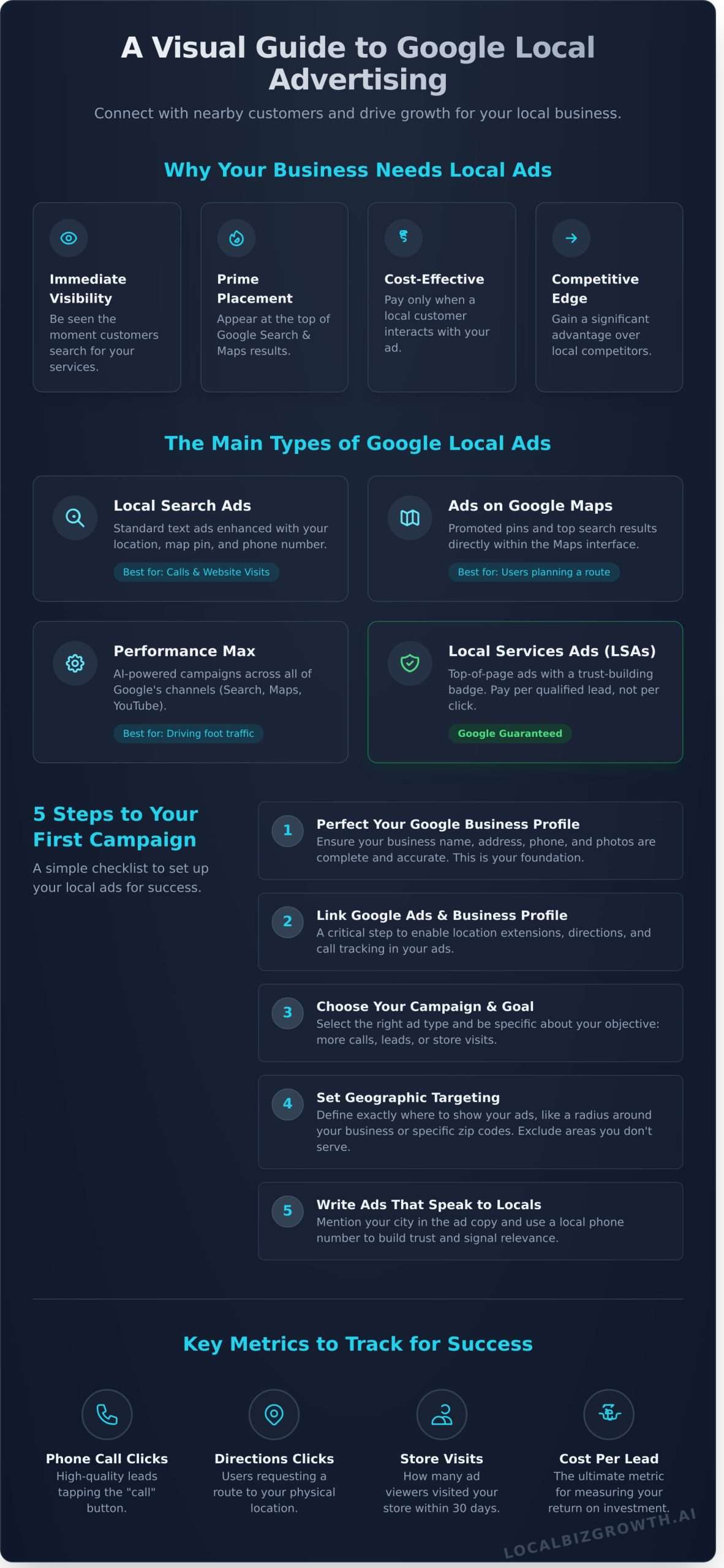
- Immediate Visibility: Be seen by potential customers at the exact moment they need your services and are searching on Google.
- Prime Placement: Appear prominently at the top of Google Search results and on Google Maps, capturing the attention of ready-to-buy customers.
- Cost-Effective: You only pay when a potential local customer interacts with your ad, such as by clicking to call or visiting your website, making it a highly efficient use of your marketing budget.
- Competitive Advantage: Gain a significant edge over competitors in your area who aren’t taking advantage of targeted local ads.
The Main Types of Google Local Ads Explained
Google offers several different tools and campaign types designed to help you target local customers. Understanding the options is the first step to choosing the right strategy for your specific business type and growth goals. Here are the most common and effective formats.
Local Search Ads (Using Location Extensions)
This is the most common form of local advertising. It takes a standard Google text ad and supercharges it with your business’s location information. By linking your Google Ads account to your Google Business Profile, your ads can automatically show your address, a map pin, and your phone number. This format is best for almost any local business aiming to drive more phone calls, website inquiries, and requests for directions.
Ads on Google Maps
You can promote your business directly within the Google Maps interface, a platform millions of people use daily for navigation and local discovery. Your business can appear as a promoted pin on the map or at the top of the search results when a user looks for a service like “plumber near me.” This is ideal for capturing the attention of users who are actively planning a route or exploring a specific area for services like yours.
This concept scales from small businesses to major industrial operations. For example, a company servicing massive container ships would target the specific geography of a major waterway. To see a real-world example of a business operating in such a critical location, you can visit Panama Ship Service.
Performance Max Campaigns for Local Goals
Performance Max (PMax) is a highly automated, AI-powered campaign type that promotes your business across all of Google’s channels, including YouTube, Display, Search, and Maps. When you set a local goal, such as in-person store visits, Google’s AI works to optimize your ads to drive foot traffic. This campaign type is an excellent choice for businesses with physical locations, such as retail stores, restaurants, and local service providers.
Local Services Ads (LSAs)
Appearing at the very top of Google’s search results-even above standard ads-Local Services Ads are a powerful tool for specific home service industries like plumbers, electricians, locksmiths, and HVAC technicians. These ads feature a “Google Guaranteed” or “Google Screened” badge, which builds immediate trust with potential customers.
For a real-world example of a business that thrives on this immediacy, you can discover Expert Deblok, an emergency locksmith service. A key benefit of this ad type is that you pay per qualified lead (a direct phone call or message), not just per click, ensuring your budget is spent on genuine inquiries.
How to Start Your First Local Campaign in 5 Steps
Launching a successful local ad campaign doesn’t have to be complicated. By following this simple checklist, you can ensure your ads are set up correctly to attract customers in your service area and achieve your business goals.
Step 1: Perfect Your Google Business Profile
Your Google Business Profile (GBP) is the absolute foundation of all local marketing efforts. Before you spend a dollar on ads, make sure your profile is complete and accurate. Ensure your business name, address, and phone number (NAP) are correct, upload high-quality photos of your work and location, and actively encourage your happy customers to leave reviews.
Step 2: Link Google Ads & Your Business Profile
This simple but critical step is what enables the powerful location-based features in your ads. By linking your two Google accounts, you allow Google Ads to pull in your address, hours, and reviews, which helps you track local actions like clicks for directions and phone calls directly from your ads.
Step 3: Choose Your Campaign & Define Your Goal
Based on the ad types explained above, select the campaign that best fits your business. When setting up the campaign, Google will ask you to define your primary goal. Be specific: do you want more phone calls, more leads through your website’s contact form, or more physical store visits?
Step 4: Set Your Geographic Targeting
This is where you tell Google exactly where to show your ads. You can be as broad as a state or as specific as a single zip code or a radius around your business address. To avoid wasted ad spend, be sure to exclude any areas you don’t serve. A good strategy is to start with a smaller, core service area and expand your targeting as you begin to see positive results.
This principle applies even to businesses that aren’t traditionally ‘local.’ For instance, a specialized travel agency like iMusafir.pk might target potential tourists in specific countries or cities, effectively using ‘local’ targeting on a global scale.
Step 5: Write Ads That Speak to Locals
Make your ads resonate with your local audience. Mention your city or service area directly in the ad headline or description to immediately signal relevance. You can also highlight local-specific offers, like “Free Estimates in [Your City],” to attract attention. Always use a local phone number to build trust and encourage calls. Feeling overwhelmed by the details? Let our experts manage your local ads for you.
Is Google Local Advertising Worth It?
Absolutely, but success requires looking beyond simple metrics like clicks. To understand if your investment is paying off, you need to focus on the performance indicators that truly matter for a local business and have a clear understanding of your budget.
Key Performance Indicators (KPIs) to Track
- Phone Call Clicks: How many people tapped the “call” button directly from your ad? This is a primary indicator of a high-quality lead.
- Directions Clicks: How many users requested directions to your physical location? This is a strong signal of intent to visit.
- Store Visits: For eligible businesses, Google can measure how many users saw your ad and then visited your store within 30 days.
- Cost Per Lead: Ultimately, what matters most is how much you are paying for each new customer inquiry. This helps you measure your true return on investment.
Budgeting for Your Local Campaign
One of the great things about Google Ads is its flexibility; you can start with almost any budget, even as little as $10-$20 per day. The right budget for your business will depend on your industry’s competitiveness and your growth goals. The key is to stop focusing on total ad spend and start focusing on your return on investment (ROI). If you are consistently generating profitable leads, your ad budget becomes a powerful investment in growth.
Frequently Asked Questions
How much does Google local advertising cost?
The cost varies widely based on your industry, location, and the level of competition. You set your own daily budget and can start with an amount you’re comfortable with. The system works on a pay-per-click (or pay-per-lead for LSAs) model, so you only pay when someone engages with your ad.
Do I need a website to run Google local ads?
While a website is highly recommended, it’s not strictly necessary for all ad types. Campaigns focused on driving phone calls or utilizing your Google Business Profile can run without a website. However, a professional website provides a much better user experience and more opportunities to convert leads.
What’s the difference between local ads and local SEO?
Local ads (PPC) provide immediate visibility at the top of Google for a cost, and the results stop as soon as you stop paying. Local SEO is an organic, long-term strategy to improve your rankings naturally over time. The best results come from using both strategies together.
How long does it take to see results from local ads?
You can start seeing traffic, clicks, and calls almost immediately after your campaign is approved and launched, often within 24-48 hours. Optimizing the campaign for the best possible return on investment typically takes a few weeks as data is gathered.
Can I target a specific neighborhood or zip code?
Yes. Google Ads provides very granular geographic targeting options, allowing you to target specific zip codes, cities, or even draw a radius of a certain number of miles around your business location.
Navigating the world of Google Ads can seem complex, but the rewards for your local business are immense. By focusing on the right campaign types and targeting customers in your service area, you can generate a steady stream of high-quality leads that fuel your growth. If you’re ready to put your business on the map and attract more local customers, it’s time to take action. Ready to get more local customers? Get your free proposal today!